 Photo unavailable
Photo: Charles Homler d/b/a FocusOnWildlife · CC BY-SA 4.0 ↗
Calidris alpina
Dunlin
A familiar small, long-billed wader of winter mudflats.
A recording has not been added yet. Use the identification notes below for now.
I know this bird · Record a sighting Where to look & how to find it ↓FIELDCRAFT · FIND WITH CARE
Finding guide
Choose the season, find the habitat, then watch patiently. Search guidance is not a measure of rarity or conservation status.
- When to go
- Most accessible in autumn and winter; also breeds locally
- Where to start
- Estuary paths and hides overlooking tidal flats; do not flush roosting flocks.
- What to do when you arrive
- In autumn and winter, scan small estuary waders and compare slightly downcurved bills. Winter birds lack the summer black belly patch; do not scatter the flock.
Habitat and behaviour reference: BirdWatch Ireland ↗ · The practical steps are editorial advice based on the references, not live sightings.
How to identify it
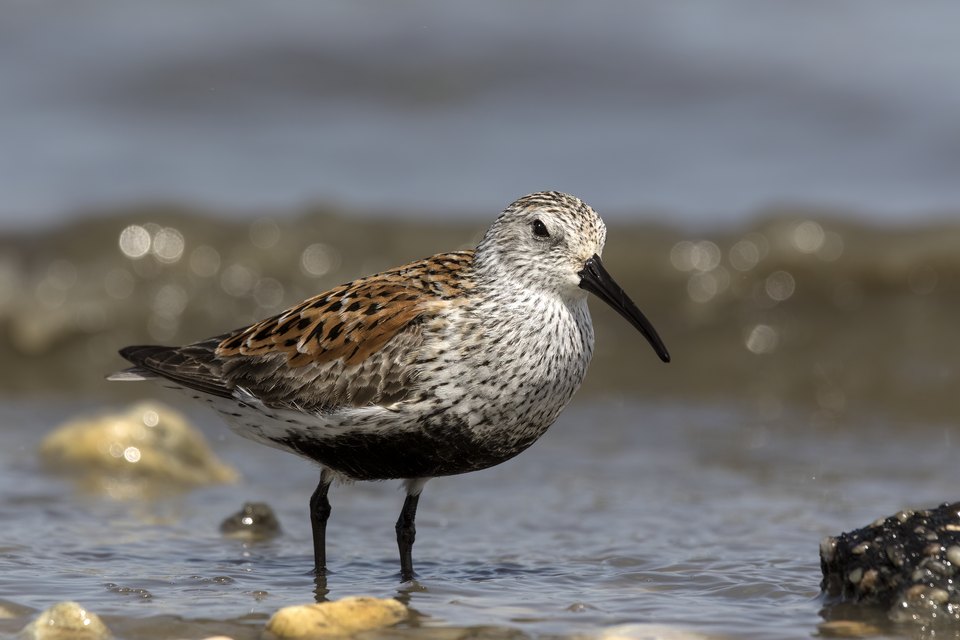
Black legs and a slightly downcurved black bill. Breeding birds have a black belly patch and rusty back; winter birds are grey and white. Smaller and longer-billed than Knot.
Habitat
Estuaries, intertidal mud and sand, and coastal shallows.
Behaviour
Probes soft mud for worms and other invertebrates.
When to look
Most accessible in autumn and winter; also breeds locally
Where to look
Estuary paths and hides overlooking tidal flats; do not flush roosting flocks.
Reference photos do not show every sex, age, season or geographic form; use the identification notes too.
Further reading:BirdWatch Ireland ↗ · BTO · Knot and Dunlin ↗ · Wikipedia ↗
COMMUNITY SIGHTINGS
Recent encounters
No public sightings yet.
Yours could be the first.