 Photo unavailable
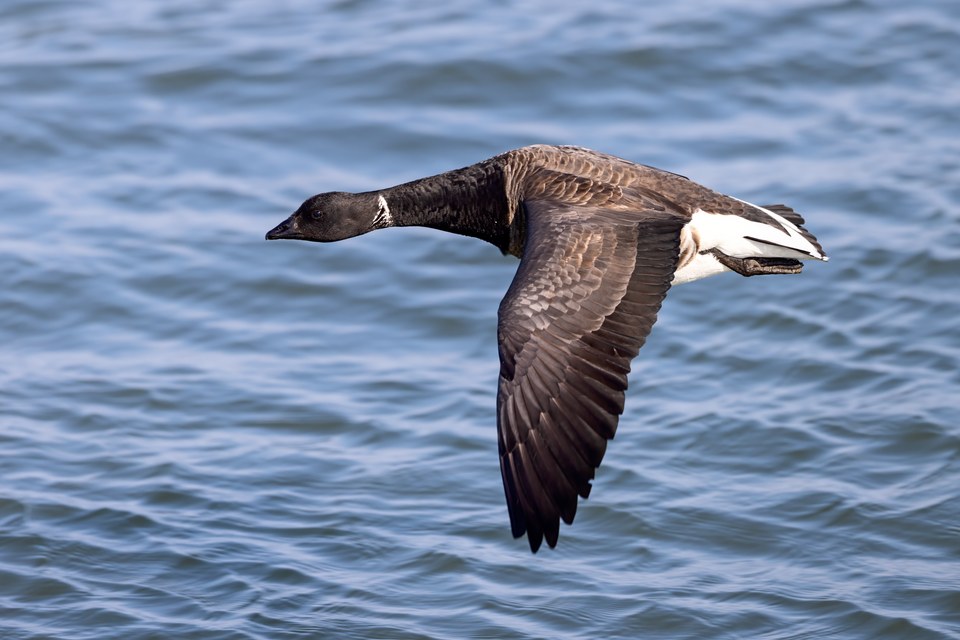
Photo: Needsmoreritalin · CC BY-SA 4.0 ↗
Branta bernicla
Brent Goose
An iconic winter visitor to Dublin. Most belong to the light-bellied subspecies, travelling from the High Arctic to feed around the bay and on coastal lawns.
A recording has not been added yet. Use the identification notes below for now.
I know this bird · Record a sighting Where to look & how to find it ↓FIELDCRAFT · FIND WITH CARE
Finding guide
Choose the season, find the habitat, then watch patiently. Search guidance is not a measure of rarity or conservation status.
- When to go
- Mainly September–April; some remain into May
- Where to start
- Bull Island, Clontarf, Sandymount Strand and coastal grassland around Dublin Bay. Give feeding flocks plenty of space.
- What to do when you arrive
- In autumn and winter, scan coastal grassland and shallow bays for flocks of small geese. Check the black neck and pale neck patch from paths; never flush grazing birds.
Habitat and behaviour reference: BirdWatch Ireland ↗ · The practical steps are editorial advice based on the references, not live sightings.
How to identify it
A small goose with black head and neck, small white neck patches and white undertail coverts. Dublin’s light-bellied birds are pale below. Young birds may lack clear neck patches; belly colour varies among subspecies.
Habitat
Shallow bays, tidal shores, saltmarsh and coastal grassland.
Behaviour
Feeds on eelgrass, algae and grass, often in close-knit winter flocks. Leaves Ireland in spring for northern breeding grounds.
When to look
Mainly September–April; some remain into May
Where to look
Bull Island, Clontarf, Sandymount Strand and coastal grassland around Dublin Bay. Give feeding flocks plenty of space.
Reference photos do not show every sex, age, season or geographic form; use the identification notes too.
Further reading:BirdWatch Ireland ↗
COMMUNITY SIGHTINGS
Recent encounters
No public sightings yet.
Yours could be the first.