 Photo unavailable
Photo: Kieran Roy Powell · CC BY 4.0 ↗
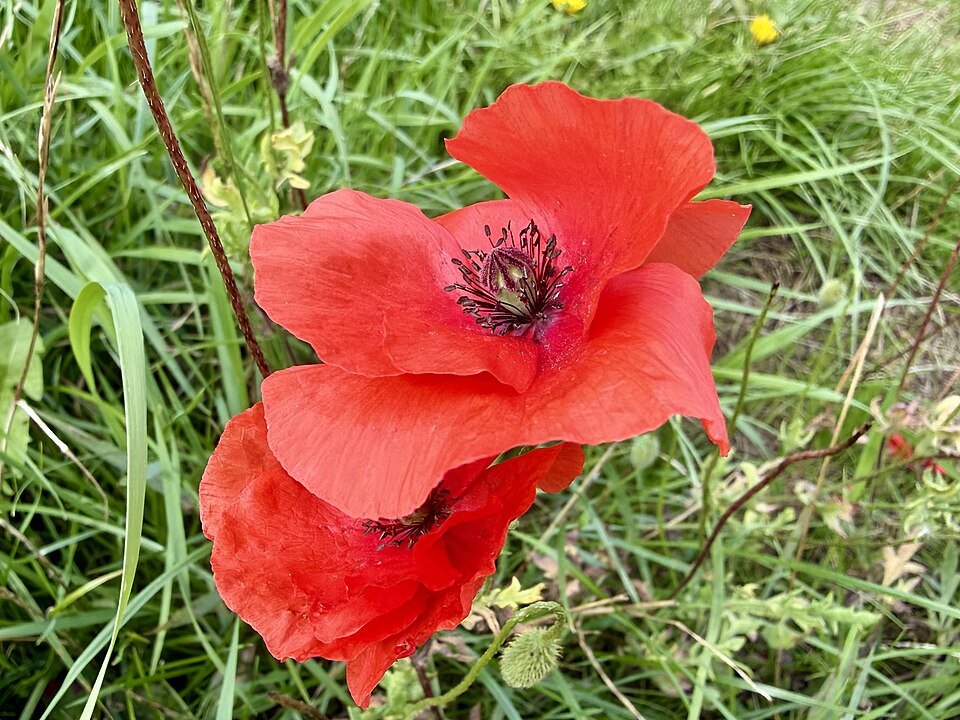
Papaver rhoeas
Common Poppy
Paper-thin red petals stand out beside fields and in gardens. Seen in Ireland does not mean endemic or necessarily native.
See all four seasons Explore fruits, seeds & edibility ↓ Where to look & how to find it ↓Some plants are poisonous. Do not identify by a photograph alone, and never taste them.
FIELDCRAFT · FIND WITH CARE
Finding guide
Choose the season, find the habitat, then watch patiently. Search guidance is not a measure of rarity or conservation status.
- When to go
- Mainly flowers June–August.
- Where to start
- Irish sown wildflower strips, gardens and field edges. Do not trample crops to reach flowers.
- What to do when you arrive
- In summer, view red flowers on disturbed ground or sown strips from public routes, then look for capsules later. Garden poppies include several species; red colour alone is not diagnostic.
Habitat and behaviour reference: Wildflowers of Ireland ↗ · The practical steps are editorial advice based on the references, not live sightings.
ONE PLANT · FOUR SEASONS
One plant. Four seasons.
Look beyond the flowers: fresh leaves, fruits, bare stems and dormancy.
Meteorological seasons: spring March–May, summer June–August, autumn September–November and winter December–February. Irish weather, cultivar, pruning and plant age affect timing and appearance.
Photos illustrate the relevant feature, not the same plant photographed through a year in Ireland. Features shared across seasons, such as evergreen leaves, may use the same reference. Missing reliable photos are marked; dormancy is not death.
Spring
Mar–May Photo unavailable
Feature reference photo ↗
Foliage and growth
Seedlings develop divided leaves; autumn-germinated plants may already form rosettes.
Summer
Jun–Aug Photo unavailable
Feature reference photo ↗
Flowers
Papery red petals and dark centres stand out, soon followed by capsules.
Autumn
Sep–NovSeeds and spent flowers
Dry capsules release tiny seeds and flowered annual plants die.
Winter
Dec–FebUnderground or seed dormancy
Mostly seeds in soil or young seedlings; the previous flowering stems usually no longer grow.
Seasonal references: Wildflowers of Ireland ↗ · Photo resized, converted to JPEG and stripped of metadata.
FRUIT · SEED · FOOD SAFETY
Fruits, seeds & edibility
Know the structure, then the part. Recognising a plant does not make it food.
Fruit
 Photo unavailable
A common-poppy capsule and its apical disc; not evidence of food-grade seeds.
Meneerke bloem · CC BY-SA 3.0 ↗ License termsA rounded to egg-shaped capsule has a flat disc on top; ripe seeds escape through pores beneath it.
- Food use of this part
- Do not eat
Seeds & dispersal units
Refer to the description below until a suitable photo is verified; flowers or other species are not substituted.
Seeds are small, kidney-shaped and dark; culinary poppy-seed guidance cannot simply be applied to this species.
- Food use of this part
- Do not eat
Some seed references show intact one-seeded fruits or dispersal units, as identified in their captions. A whole-fruit photo is not a close-up of the enclosed seed. Cones and arils are not true fruits of flowering plants.
Sources & limitations
- Wildflowers of Ireland ↗ · Botanical description, not proof of food safety
- Clinical case report · Papaver rhoeas poisoning ↗
- NC State Extension · Plant Toolbox ↗
No field detoxification methods or safe doses are provided. Never taste a plant to identify it or eat treated or contaminated specimens. Seek professional help after suspected accidental ingestion. National Poisons Information Centre, Ireland ↗
Photo resized, converted to JPEG and stripped of metadata.
How to identify it
Four red petals, often with dark bases, and dark stamens; hairy stalks later carry capsules topped by a flat disc.
Where it grows
Arable margins, disturbed ground, verges and sown flower strips.
Growth and ecology
An annual that can emerge from a persistent seed bank after disturbance; it may not flower at the same spot every year.
Flowering and seasons
Mainly flowers June–August.
Where to look
Irish sown wildflower strips, gardens and field edges. Do not trample crops to reach flowers.
Seasons vary with weather and location. Suggested habitats are places to look, not guaranteed sightings. Photos show only some features; check leaves, flowers, fruits and specialist references together.
Further reading:Wildflowers of Ireland ↗
Photo license: Kieran Roy Powell · CC BY 4.0 ↗ · License terms ↗
Photo resized, converted to JPEG and stripped of metadata.