 Photo unavailable
Photo: Trougnouf (Benoit Brummer) · CC BY 4.0 ↗
Salix caprea
Goat Willow
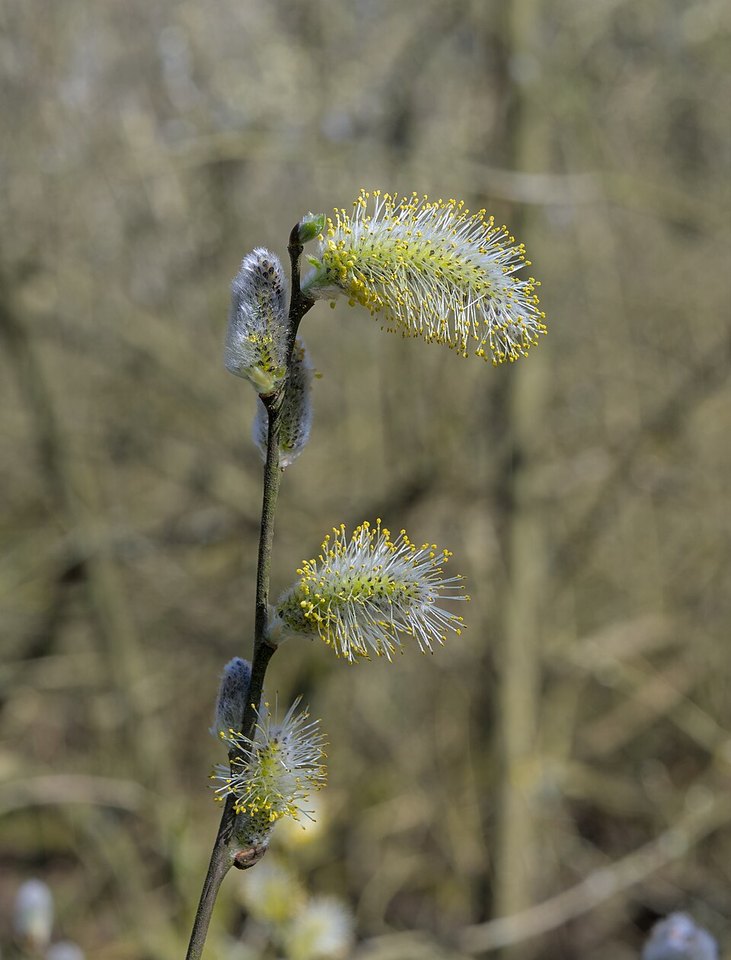
Furry pussy-willow catkins open before the broad leaves, providing food for early insects.
See all four seasons Explore fruits, seeds & edibility ↓ Where to look & how to find it ↓Some plants are poisonous. Do not identify by a photograph alone, and never taste them.
FIELDCRAFT · FIND WITH CARE
Finding guide
Choose the season, find the habitat, then watch patiently. Search guidance is not a measure of rarity or conservation status.
- When to go
- Prominent spring catkins, summer leaves and bare winter twigs.
- Where to start
- Irish woodland gaps and rough verges. Not every pussy willow belongs to the same willow species.
- What to do when you arrive
- In early spring, look for silver-grey to yellow catkins, then check broad leaves and their undersides in summer. Garden pussy willows may be other species; favour clearly labelled plants.
Habitat and behaviour reference: Tree Council of Ireland ↗ · The practical steps are editorial advice based on the references, not live sightings.
Markers show approximate public destinations or visitor bases, not individuals, nests, rare plants or exact entrances. Follow the operator’s routes and signs for access.
Base map: Natural Earth · Public domain
Destination positions: © OpenStreetMap contributors · ODbL
-
Muckross Gardens · cultivated plants
Operator or specialist guide · Cultivated plants, not wild records
The official gardens description explicitly names Salix caprea. This is a cultivated viewing destination, not a wild distribution record. The marker is the visitor area; check individual plants and labels on site.
Before you goCheck current garden hours, not house-tour times or general park access hours. Stay on open garden paths; do not handle or collect plants or enter maintenance areas.
Destination evidence & review date
Sources reviewed: · A review date is not a sighting date; recheck access before travelling.
ONE PLANT · FOUR SEASONS
One plant. Four seasons.
Look beyond the flowers: fresh leaves, fruits, bare stems and dormancy.
Meteorological seasons: spring March–May, summer June–August, autumn September–November and winter December–February. Irish weather, cultivar, pruning and plant age affect timing and appearance.
Photos illustrate the relevant feature, not the same plant photographed through a year in Ireland. Features shared across seasons, such as evergreen leaves, may use the same reference. Missing reliable photos are marked; dormancy is not death.
Spring
Mar–May Photo unavailable
Feature reference photo ↗
Flowers
Furry catkins open before the leaves, with male catkins often bright yellow.
Summer
Jun–Aug Photo unavailable
Feature reference photo ↗
Foliage and growth
Broad leaves form the crown, with grey hairs on their undersides.
Autumn
Sep–Nov Photo unavailable
Feature reference photo ↗
Foliage and growth
Leaves yellow and fall as buds prepare for next year's catkins.
Winter
Dec–Feb Photo unavailable
Feature reference photo ↗
Shoots and buds
Buds show clearly on bare twigs; catkins may begin emerging in mild late winter.
Seasonal references: Tree Council of Ireland ↗ · Photo resized, converted to JPEG and stripped of metadata.
FRUIT · SEED · FOOD SAFETY
Fruits, seeds & edibility
Know the structure, then the part. Recognising a plant does not make it food.
Fruit
 Photo unavailable
Goat-willow capsules releasing silky-haired seeds.
T. Kebert · CC BY-SA 4.0 ↗ License termsSmall capsules line the female fruiting catkins and split when ripe.
- Food use of this part
- Food safety not established by this guide
Seeds & dispersal units
 Photo unavailable
Tiny goat-willow seeds with white silky hairs.
Abrahami · CC BY-SA 4.0 ↗ License termsNumerous tiny seeds carry white silky hairs for wind dispersal; these hairs are not petals.
- Food use of this part
- Food safety not established by this guide
Some seed references show intact one-seeded fruits or dispersal units, as identified in their captions. A whole-fruit photo is not a close-up of the enclosed seed. Cones and arils are not true fruits of flowering plants.
Sources & limitations
- Tree Council of Ireland ↗ · Botanical description, not proof of food safety
- NC State Extension · Plant Toolbox ↗
No field detoxification methods or safe doses are provided. Never taste a plant to identify it or eat treated or contaminated specimens. Seek professional help after suspected accidental ingestion. National Poisons Information Centre, Ireland ↗
Photo resized, converted to JPEG and stripped of metadata.
How to identify it
Leaves broader than many willows, with grey hairs beneath; male catkins turn yellow in flower. Willows hybridise, so compare twigs, buds, leaves and catkins.
Where it grows
Woodland edges, rough ground, damp or disturbed sites and plantings.
Growth and ecology
A deciduous small tree or large shrub with separate male and female plants; fluffy seeds travel on the wind.
Flowering and seasons
Prominent spring catkins, summer leaves and bare winter twigs.
Where to look
Irish woodland gaps and rough verges. Not every pussy willow belongs to the same willow species.
Seasons vary with weather and location. Suggested habitats are places to look, not guaranteed sightings. Photos show only some features; check leaves, flowers, fruits and specialist references together.
Further reading:Tree Council of Ireland ↗
Photo license: Trougnouf (Benoit Brummer) · CC BY 4.0 ↗ · License terms ↗
Photo resized, converted to JPEG and stripped of metadata.