 Photo unavailable
Photo: Percita at Flickr · CC BY-SA 2.0 ↗
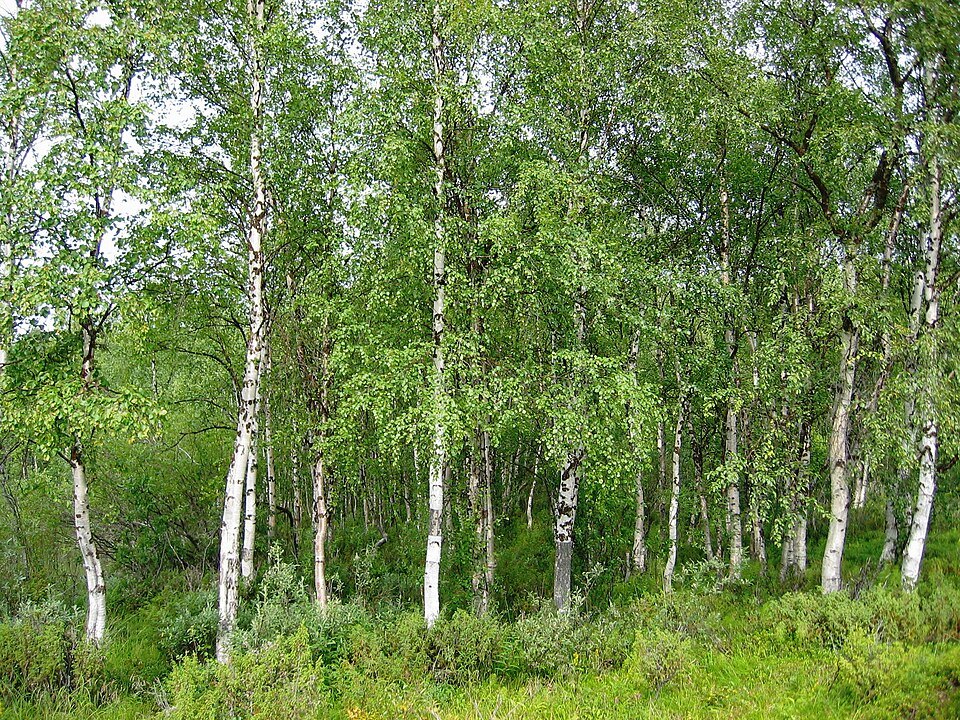
Betula pendula
Silver Birch
White bark, small triangular leaves and drooping twigs give silver birch a light silhouette. It is also planted in Irish parks.
See all four seasons Explore fruits, seeds & edibility ↓ Where to look & how to find it ↓Some plants are poisonous. Do not identify by a photograph alone, and never taste them.
FIELDCRAFT · FIND WITH CARE
Finding guide
Choose the season, find the habitat, then watch patiently. Search guidance is not a measure of rarity or conservation status.
- When to go
- Catkins in spring; study leaves in summer and bark and twigs in winter.
- Where to start
- Start with birches in Irish parks. Downy birch is more widespread in the wild: not every white-barked birch is silver birch.
- What to do when you arrive
- Start with clearly labelled park trees, comparing fine drooping twigs, leaf margins and bark with Downy Birch. White bark alone does not establish Silver Birch.
Habitat and behaviour reference: Tree Council of Ireland ↗ · The practical steps are editorial advice based on the references, not live sightings.
ONE PLANT · FOUR SEASONS
One plant. Four seasons.
Look beyond the flowers: fresh leaves, fruits, bare stems and dormancy.
Meteorological seasons: spring March–May, summer June–August, autumn September–November and winter December–February. Irish weather, cultivar, pruning and plant age affect timing and appearance.
Photos illustrate the relevant feature, not the same plant photographed through a year in Ireland. Features shared across seasons, such as evergreen leaves, may use the same reference. Missing reliable photos are marked; dormancy is not death.
Spring
Mar–May Photo unavailable
Feature reference photo ↗
Shoots and buds
Buds open on fine twigs with catkins and small fresh leaves.
Summer
Jun–Aug Photo unavailable
Feature reference photo ↗
Foliage and growth
Triangular toothed leaves form a light crown, with some drooping twig tips.
Autumn
Sep–Nov Photo unavailable
Feature reference photo ↗
Foliage and growth
Leaves often turn yellow as mature catkins release small seeds.
Winter
Dec–Feb Photo unavailable
Feature reference photo ↗
Bare branches or dry stems
White bark and fine branches are exposed; not every white-barked birch is this species.
Seasonal references: Tree Council of Ireland ↗ · Photo resized, converted to JPEG and stripped of metadata.
FRUIT · SEED · FOOD SAFETY
Fruits, seeds & edibility
Know the structure, then the part. Recognising a plant does not make it food.
Fruit
 Photo unavailable
Silver-birch fruiting catkins before the nutlets disperse.
Andrey Butko · CC BY-SA 3.0 ↗ License termsMature female catkins break up and release tiny nuts with wings on either side.
- Food use of this part
- Food safety not established by this guide
Seeds & dispersal units
 Photo unavailable
A winged silver-birch nutlet; the seed remains inside the fruit wall.
Akroti · CC BY-SA 3.0 ↗ License termsThe winged units often called birch seeds are actually fruits enclosing the seed.
- Food use of this part
- Food safety not established by this guide
Some seed references show intact one-seeded fruits or dispersal units, as identified in their captions. A whole-fruit photo is not a close-up of the enclosed seed. Cones and arils are not true fruits of flowering plants.
Sources & limitations
- Tree Council of Ireland ↗ · Botanical description, not proof of food safety
- NC State Extension · Plant Toolbox ↗
No field detoxification methods or safe doses are provided. Never taste a plant to identify it or eat treated or contaminated specimens. Seek professional help after suspected accidental ingestion. National Poisons Information Centre, Ireland ↗
Photo resized, converted to JPEG and stripped of metadata.
How to identify it
Leaves are usually triangular or diamond-shaped with doubly toothed margins; young twigs are normally hairless. The lower bark darkens and fissures with age. Use several features to separate downy birch and hybrids.
Where it grows
Relatively dry, well-drained open woodland and poor soils, as well as planted settings.
Growth and ecology
A light-demanding deciduous pioneer of open ground. Wind pollinates its catkins and disperses the small seeds.
Flowering and seasons
Catkins in spring; study leaves in summer and bark and twigs in winter.
Where to look
Start with birches in Irish parks. Downy birch is more widespread in the wild: not every white-barked birch is silver birch.
Seasons vary with weather and location. Suggested habitats are places to look, not guaranteed sightings. Photos show only some features; check leaves, flowers, fruits and specialist references together.
Further reading:Tree Council of Ireland ↗
Photo license: Percita at Flickr · CC BY-SA 2.0 ↗ · License terms ↗
Photo resized, converted to JPEG and stripped of metadata.