 Photo unavailable
Photo: Didier Descouens · CC BY-SA 4.0 ↗
Taxus baccata
Yew
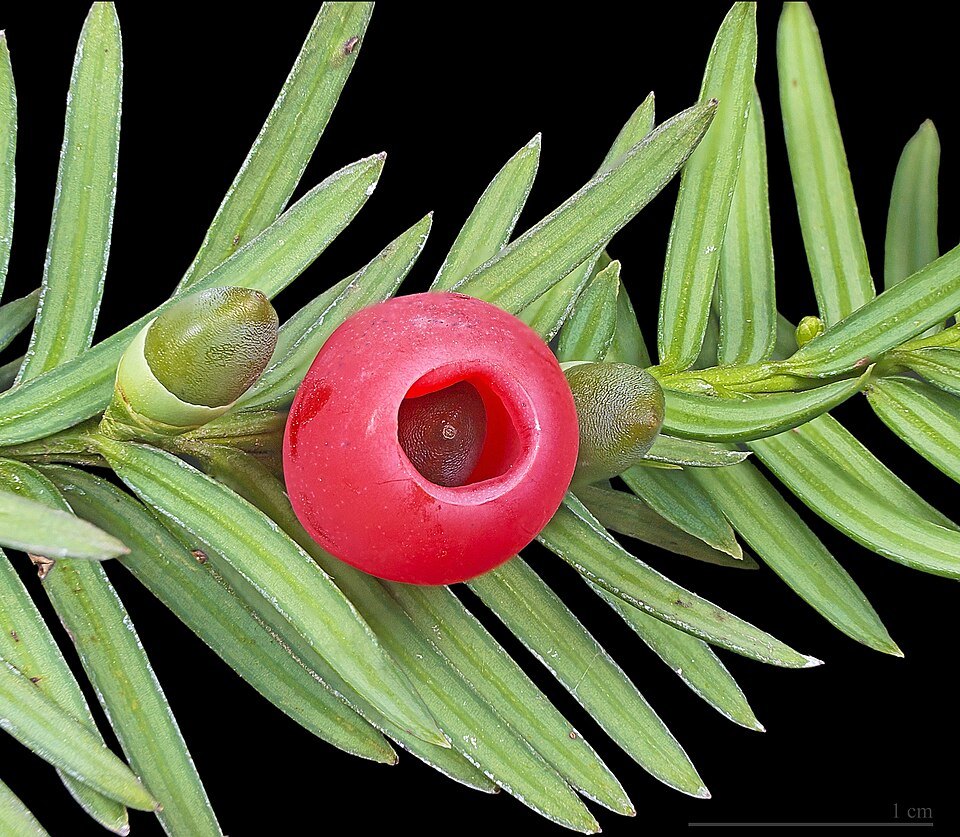
Dark needles and red cup-like arils stand out through the year; columnar Irish yew is a cultivated form of this species.
See all four seasons Explore fruits, seeds & edibility ↓ Where to look & how to find it ↓Some plants are poisonous. Do not identify by a photograph alone, and never taste them.
FIELDCRAFT · FIND WITH CARE
Finding guide
Choose the season, find the habitat, then watch patiently. Search guidance is not a measure of rarity or conservation status.
- When to go
- Evergreen throughout the year; red arils on female trees are most obvious in autumn.
- Where to start
- Irish estates and churchyards, and designated paths in Killarney's yew woodland.
- What to do when you arrive
- All year, view flat evergreen leaves and reddish bark from established paths. Red arils on female trees add an autumn clue, but fruitless trees can also be Yew. Observe without eating or collecting.
Habitat and behaviour reference: Tree Council of Ireland ↗ · The practical steps are editorial advice based on the references, not live sightings.
Markers show approximate public destinations or visitor bases, not individuals, nests, rare plants or exact entrances. Follow the operator’s routes and signs for access.
Base map: Natural Earth · Public domain
Destination positions: © OpenStreetMap contributors · ODbL
-
Muckross base · Reenadinna public woodland walk
Operator or specialist guide
NPWS explicitly names Yew, Hazel, Ash and Holly in the yew woodland, reached by an official walk. The marker is only the Muckross visitor base, not an individual tree location.
Before you goUse official routes such as Arthur Young’s Walk and current notices, staying on paths to protect moss and roots. Gardens have separate hours; woodland routes may close for flooding, falling branches or management. Do not collect plants.
Destination evidence & review date
Sources reviewed: · A review date is not a sighting date; recheck access before travelling.
ONE PLANT · FOUR SEASONS
One plant. Four seasons.
Look beyond the flowers: fresh leaves, fruits, bare stems and dormancy.
Meteorological seasons: spring March–May, summer June–August, autumn September–November and winter December–February. Irish weather, cultivar, pruning and plant age affect timing and appearance.
Photos illustrate the relevant feature, not the same plant photographed through a year in Ireland. Features shared across seasons, such as evergreen leaves, may use the same reference. Missing reliable photos are marked; dormancy is not death.
Spring
Mar–May Photo unavailable
Feature reference photo ↗
Flowers
Small reproductive structures appear among evergreen needles and paler new shoots.
Summer
Jun–Aug Photo unavailable
Feature reference photo ↗
Evergreen foliage
Dark foliage persists while seeds and arils develop on female plants.
Autumn
Sep–Nov Photo unavailable
Feature reference photo ↗
Fruits
Some female plants carry red cup-like arils around poisonous seeds.
Winter
Dec–Feb
Photo unavailable
Feature reference photo ↗
Evergreen foliage
Needles persist; remaining red structures depend on the plant's sex and bird feeding.
Seasonal references: Tree Council of Ireland ↗ · Photo resized, converted to JPEG and stripped of metadata.
FRUIT · SEED · FOOD SAFETY
Fruits, seeds & edibility
Know the structure, then the part. Recognising a plant does not make it food.
Aril, not a true fruit
Photo unavailable
Red arils surround poisonous seeds; these are not berries.
Jonathan Billinger · CC BY-SA 2.0 ↗ License termsNo true fruits: the red fleshy cup is an aril, not a berry.
- Food use of this part
- Do not eat
Seeds & dispersal units
 Photo unavailable
Actual poisonous yew seeds, not edible nuts.
Didier Descouens · CC BY-SA 4.0 ↗ License termsOne hard seed is visible through the aril opening; the seed is poisonous and must not be eaten.
- Food use of this part
- Do not eat
Some seed references show intact one-seeded fruits or dispersal units, as identified in their captions. A whole-fruit photo is not a close-up of the enclosed seed. Cones and arils are not true fruits of flowering plants.
Sources & limitations
- Tree Council of Ireland ↗ · Botanical description, not proof of food safety
- NC State Extension · Plant Toolbox ↗
No field detoxification methods or safe doses are provided. Never taste a plant to identify it or eat treated or contaminated specimens. Seek professional help after suspected accidental ingestion. National Poisons Information Centre, Ireland ↗
Photo resized, converted to JPEG and stripped of metadata.
How to identify it
Flat soft needles often arranged in two ranks. Female trees may bear red cups around single seeds, rather than ordinary berries.
Where it grows
Old woods, estates, churchyards and clipped hedges.
Growth and ecology
A long-lived evergreen. Leaves and seeds are highly poisonous; do not eat any part or leave cuttings accessible to pets or livestock.
Flowering and seasons
Evergreen throughout the year; red arils on female trees are most obvious in autumn.
Where to look
Irish estates and churchyards, and designated paths in Killarney's yew woodland.
Seasons vary with weather and location. Suggested habitats are places to look, not guaranteed sightings. Photos show only some features; check leaves, flowers, fruits and specialist references together.
Further reading:Tree Council of Ireland ↗
Photo license: Didier Descouens · CC BY-SA 4.0 ↗ · License terms ↗
Photo resized, converted to JPEG and stripped of metadata.